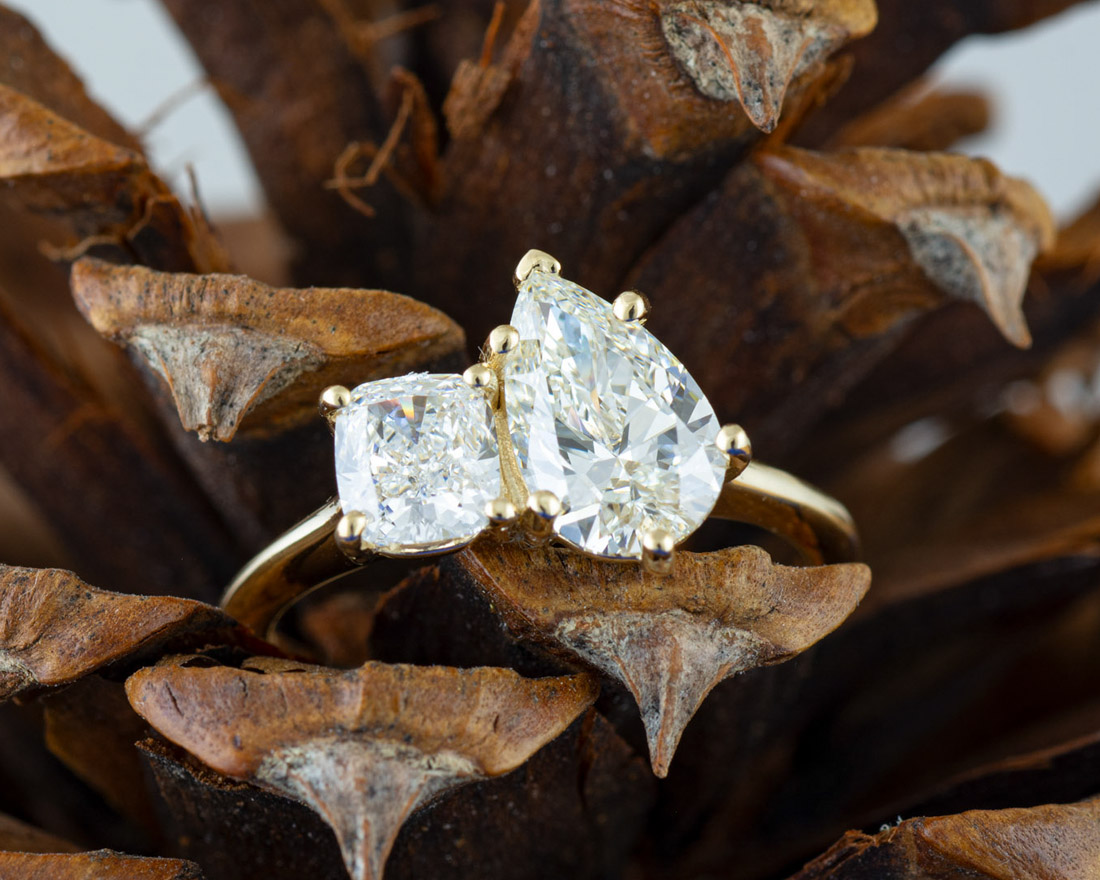
That difference becomes particularly interesting when the rings are worn outside the showroom. Under natural light, moissanite may produce colourful flashes that are less pronounced in a diamond. Some people adore that effect. Others prefer the familiar appearance of a diamond.
Neither preference is wrong. The useful question is what those differences mean for the ring someone intends to wear every day.
The Difference Goes Beyond Appearance
Diamond is made of crystallised carbon. Natural diamonds form underground, while laboratory-grown diamonds are produced using specialised technology that recreates diamond’s crystal structure.
Moissanite is a separate gemstone made of silicon carbide. Although naturally occurring moissanite exists, the stones used in modern engagement rings are generally laboratory-created.
This distinction matters because moissanite is sometimes confused with lab-grown diamond. They are not interchangeable materials.
A lab-grown diamond is still a diamond, possessing essentially the same chemical, physical and optical properties as a natural diamond. Moissanite has its own properties and appearance.
For someone researching moissanite vs diamond, understanding this distinction makes it easier to compare traditional diamonds, laboratory-grown diamonds and alternative gemstones without confusing their origins or characteristics.
Why Sparkle Looks Different in Each Stone
Sparkle is probably the easiest difference to appreciate without specialist equipment.
Diamonds reflect white light and produce coloured flashes known as fire. Their appearance depends heavily on the quality of the cut, including facet angles, proportions and symmetry.
Moissanite has higher light dispersion than diamond. This means it separates incoming white light into spectral colours more strongly, producing noticeable rainbow flashes.
The difference becomes particularly visible in direct sunlight or under bright, concentrated lighting.
There is also an optical characteristic called double refraction. Moissanite can split light travelling through the gemstone, sometimes making certain facet edges appear doubled under magnification.
Diamonds are ordinarily singly refractive, so they do not display this same optical effect.
For an engagement ring, these differences influence the overall look.
Someone who enjoys colourful flashes might prefer moissanite. A person attracted to the crisp contrast and balanced sparkle of a well-cut diamond may feel differently.
Photographs rarely communicate the distinction fully. Comparing videos recorded in daylight, indoor lighting and shaded conditions can be more helpful than relying on professionally lit product photographs alone.
Can Moissanite Handle Decades of Daily Wear?
Both gemstones are suitable for engagement rings intended for regular use.
Diamond receives a hardness rating of 10 on the Mohs scale, making it exceptionally resistant to scratching. Moissanite is generally rated around 9.25, which also places it among the harder gemstones used in jewellery.
Hardness, however, describes resistance to lab made diamonds rather than protection from every form of damage.
A diamond can chip after an unfortunate impact, particularly around exposed points or vulnerable edges. Moissanite can also suffer damage under sufficient force.
The setting deserves as much attention as the gemstone.
A delicate four-prong setting may expose more of the stone, while a bezel setting surrounds its edge with metal and can offer additional protection.
People who regularly work with their hands may prefer a lower-profile ring that is less likely to catch on clothing or equipment.
Neither gemstone eliminates the need for sensible handling and occasional inspections.
Does Moissanite Offer Better Value Than Diamond?
Moissanite generally costs less than a natural diamond of comparable visible dimensions.
That difference can allow a buyer to select a larger-looking centre stone while keeping more of the budget available for the ring itself.
But comparing gemstones purely by price per carat can be misleading.
Carat measures weight, not diameter. Moissanite and diamond have different densities, meaning two stones with identical dimensions will not necessarily weigh the same.
For this reason, jewellers often describe moissanite using diamond-equivalent weight or millimetre measurements.
A more practical approach is to compare how large each stone looks from above.
For example, someone considering a round engagement ring could compare stones measuring approximately 6.5 mm across rather than assuming every one-carat listing represents the same face-up appearance.
The ring’s total cost also includes the precious metal, setting complexity, accent stones and craftsmanship.
A relatively affordable centre stone does not automatically make an elaborate ring inexpensive.
Where Lab-Grown Diamonds Fit Into the Budget
Lab-grown diamonds deserve a separate comparison because they offer diamond’s physical and optical characteristics without requiring a naturally mined centre stone.
They generally cost less than comparable natural diamonds, although the actual difference varies with specifications and the retailer.
For buyers who specifically want a diamond but do not place much importance on natural geological origin, this creates another option.
Moissanite may still be the lower-cost choice, but the gap between the two categories is worth checking rather than assuming.
Stone Shape Can Make the Difference More Noticeable
Round brilliant cuts tend to emphasise sparkle in both gemstones.
With moissanite, that can create a particularly lively appearance. With diamonds, good cutting produces a balance of brightness, fire and contrasting light and dark areas.
The difference becomes interesting with elongated shapes.
Oval and pear-shaped stones can show variations in brightness across their surface. Some display darker regions commonly described as a bow-tie effect.
The appearance varies according to the individual stone’s proportions and facet arrangement.
In moissanite, pronounced dispersion and double refraction can create a different visual impression from a similarly shaped diamond.
This makes shape-specific comparisons valuable. Someone who loves a round moissanite might not necessarily prefer the appearance of an oval moissanite.
It is sensible to compare the actual shape and approximate dimensions being considered rather than judging every gemstone from a round brilliant example.
The Ring Setting Can Change the Entire Result
A gemstone is only one part of an engagement ring.
Metal colour, band width and setting height influence how prominent the centre stone appears.
Yellow gold can introduce warmth around a colourless gemstone, particularly in settings where the metal remains visible close to the stone.
White gold and platinum create a cooler overall appearance. Rose gold introduces a softer colour contrast.
The choice of setting also changes how light reaches the gemstone.
A traditional solitaire leaves much of the centre stone visible. Halo designs add smaller stones around it, increasing the ring’s apparent size and overall sparkle.
With moissanite, a halo of diamonds may create subtle differences in the character of the light reflected by the centre and surrounding stones.
That contrast can be attractive, but it should be intentional.
Buyers considering a halo or pavé band should ask whether the accent stones are diamonds, moissanite or another material.
Matching the gemstone type can produce a more consistent sparkle, while mixing materials can create a different effect.
What a Gemstone Report Actually Tells You
Independent documentation can help buyers understand exactly what they are purchasing.
Natural diamonds are commonly assessed through the four Cs: cut, colour, clarity and carat weight.
Laboratory-grown diamonds may also come with reports or quality assessments identifying their origin and relevant characteristics.
Organisations such as the Gemological Institute of America (GIA) and International Gemological Institute (IGI) provide diamond-related grading or assessment services, although their documentation formats and terminology can differ.
Moissanite should not automatically be assumed to have an equivalent independent diamond grading report.
A seller’s description of a moissanite gemstone as D colour or VVS clarity may use diamond-style terminology without representing the same independent grading process.
Before purchasing, ask who issued the document, what it verifies and whether the report number can be checked independently.
An authenticity card supplied by a retailer is not necessarily equivalent to an independent laboratory report.
For online purchases, clear gemstone specifications and accurate disclosure of the material are particularly valuable.
Buying an Engagement Ring in New Zealand
New Zealand buyers comparing engagement rings online should examine the complete order rather than focusing exclusively on the centre stone.
Ring sizing deserves early attention, particularly when ordering a custom design. A size adjustment may be straightforward for a plain band but more complicated for rings with stones extending around the shank.
It is also useful to establish whether the quoted price includes GST and whether international shipping could involve additional charges.
Before placing an order, confirm the production timeframe, delivery arrangements and policies for resizing or returning a custom-made ring.
The questions worth asking a jeweller are practical:
- What are the centre stone’s actual dimensions in millimetres?
- Is it natural diamond, lab-grown diamond or moissanite?
- What documentation accompanies the gemstone?
- Can the setting accommodate a wedding band sitting close beside it?
- What maintenance or prong inspections are recommended?
- What happens if resizing is needed after delivery?
These details can affect ownership long after the initial purchase.
Think About the Wedding Band Before Choosing the Centre Stone
An engagement ring may look beautiful on its own yet sit awkwardly beside a straight wedding band.
High-set solitaires often provide enough clearance for a matching band to sit close to the engagement ring. Lower settings, decorative baskets and certain hidden-halo designs may require a curved or shaped wedding band.
A larger centre stone can also influence how comfortably the two rings sit together.
For someone choosing moissanite primarily to achieve a larger appearance, checking the overall dimensions of the finished ring is especially useful.
A wider stone combined with a low setting might create more separation between the rings than expected.
The same concern applies to diamonds, particularly elongated shapes and settings with substantial baskets.
Before approving a custom design, request side-view photographs or a design rendering showing the engagement ring beside the intended wedding band.
This small design check may be considerably more useful than debating minor differences in gemstone specifications. A well-proportioned ring with a secure setting and a comfortable wedding-band fit is far more likely to remain practical throughout years of regular wear.